The Jabulani
The Controversial Sphere That Defined Africa's First World Cup

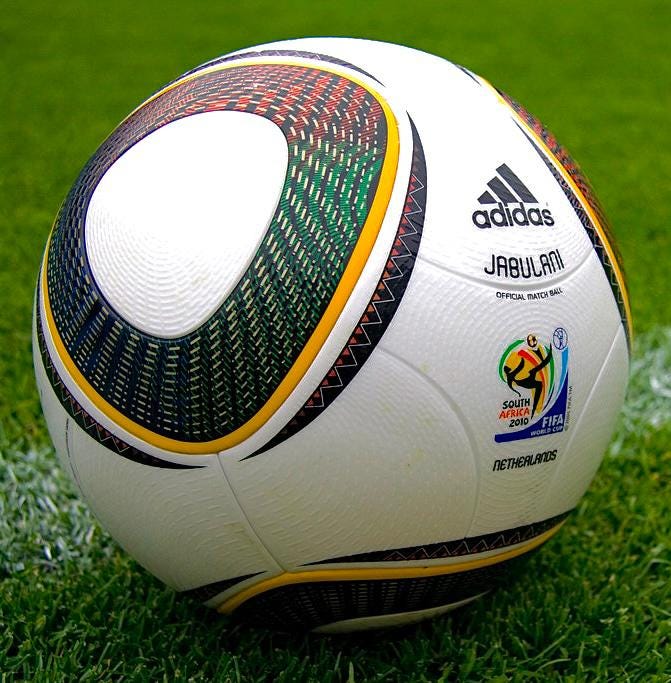
In the sprawling narrative of football history, equipment rarely steals the spotlight from the players who wield it. But in 2010, as the world's attention turned to South Africa for the first World Cup ever held on African soil, an unlikely protagonist emerged: a white and colored sphere named "Jabulani," meaning "celebrate" in isiZulu. What was designed to be a celebration of technical innovation instead became perhaps the most controversial piece of equipment in World Cup history.
The Jabulani wasn't merely controversial—it was divisive in ways that transcended everyday sporting discourse. It became a Rorschach test for how one viewed football: Was the sport primarily about technical skill and adaptation? Or was it about consistency and predictability? The debate consumed the tournament, sometimes overshadowing the historic significance of Africa's first World Cup.
This is the story of how an 8-panel ball weighing 440 grams and measuring 69 centimeters in circumference became the symbol of a tournament meant to celebrate African football's arrival on the global stage. It's a tale of physics and perception, tradition versus innovation, and how minor changes to the beautiful game can create the most significant controversies.
Engineering the "Perfect" Ball
The relationship between Adidas and the FIFA World Cup stretches back to 1970, when the German manufacturer first supplied the official match ball—the iconic Telstar—for the tournament in Mexico. Each subsequent World Cup brought incremental innovations, with Adidas treating each tournament as an opportunity to showcase its latest technological advancements.
For the 2010 World Cup, Adidas partnered with researchers at Loughborough University in England to create what they believed would be the most "perfectly round" football ever made. Previous World Cup balls had featured 14, 26, or 32 panels stitched together. The Jabulani represented a radical departure with just eight 3D-molded thermally bonded panels rather than stitched, creating an unprecedentedly smooth surface.
Dr. Andy Harland, who led the research team, explained their approach: "We wanted to create a ball that would perform consistently regardless of where it was struck. The fewer seams, the more predictable the flight path." The team spent over four years developing the ball, conducting thousands of tests in wind tunnels and with robotic legs to ensure consistency.
Adidas marketed the Jabulani as "the roundest ball ever," suggesting its performance would be superior to any previous World Cup ball. FIFA officially approved the ball in December 2009, just six months before the tournament began. A timeline that later became a point of contention.
The First Signs of Trouble
While Adidas conducted extensive testing, the real-world trials with professional players were notably limited. Only select Adidas-sponsored teams and players had access to the ball before the tournament, creating what some would later describe as an unfair advantage.
Bayern Munich was one such team, using the Jabulani in Bundesliga matches from February 2010. Not coincidentally, Bayern players were among the few who defended the ball during the subsequent controversy. "It's very good, especially in the air," said Arjen Robben, a sentiment his teammate Mark van Bommel echoed.
The German national team also received early access, training with the Jabulani months before other nations. When German goalkeeper Manuel Neuer commented that "the ball is very goalkeeper-friendly because it's unpredictable," few realized how prescient his seemingly contradictory statement would prove.
Despite these limited trials, most players and teams first encountered the Jabulani only weeks before the World Cup began—far too late for meaningful adaptation to its unique characteristics. This compressed timeline for familiarization would become a critical factor in the storm that followed.
A Ball for the Stands, Not for the Players
As teams gathered in South Africa for final preparations, early training sessions with the Jabulani produced immediate and vociferous criticism. Spanish goalkeeper Iker Casillas called it "horrible," while Italy's Gianluigi Buffon described it as "inadequate" and more suited "for the beach." Brazil's goalkeeper, Julio Cesar, compared it to a "supermarket ball that favors strikers and playmakers."
The criticism wasn't limited to goalkeepers, who might naturally resist innovation, favoring attackers. Strikers and midfielders were equally critical. England's Wayne Rooney noted that "it's awful, especially when wet," while Brazil's Robinho lamented that "it's very strange and different from what we're used to."
Perhaps the most damning assessment came from Spanish midfielder Andrés Iniesta, who would eventually score the winning goal in the final. He remarked that the ball was "like a beach ball," noting its lightness and unpredictability. When one of the tournament's most technically gifted players—someone who should theoretically benefit from an unpredictable ball—joins the criticism, it suggests problems beyond mere resistance to change.
The unprecedented unity in criticism across positions and nationalities distinguished the Jabulani controversy from previous World Cup ball debates. Even Adidas-sponsored players struggled to defend it convincingly.
The Physics of Unpredictability
We must delve into aerodynamics to understand why the Jabulani behaved so strangely. Traditional footballs with 32 panels and stitched seams create a slightly rough surface that generates a thin layer of turbulence around the ball when it travels through the air. This turbulent layer actually helps stabilize the ball's flight by creating more consistent airflow patterns.
The Jabulani's smoother surface with fewer seams significantly reduced this stabilizing turbulence, creating what aerodynamicists call "knuckling"—an unpredictable wobbling motion that makes the ball's trajectory difficult to predict. This effect becomes particularly pronounced at the speeds achieved during professional free kicks (approximately 70-80 mph).
Dr. Takeshi Asai of the University of Tsukuba in Japan conducted wind tunnel tests during the tournament and found that the Jabulani became unstable at speeds that were common in professional matches. His research showed the ball could deviate from its expected path by up to 45 centimeters over a 20-meter distance—essentially the difference between a goal and a miss on a well-struck free kick.
The physics revealed why goalkeepers like Brazil's Julio Cesar struggled to predict the ball's flight path. The Jabulani would appear to be heading in one direction before suddenly dipping, rising, or veering sideways with no apparent physical cause. For players who had spent their entire lives developing an intuitive understanding of how a football should behave, the Jabulani essentially rewrote the rules of physics.
The Impact on Play: Low Scoring and Long Shots
The Jabulani's unpredictability manifested in the tournament's play patterns and statistics:
Reduced scoring: The 2010 World Cup averaged 2.27 goals per match, the second-lowest in World Cup history at that time. Many attributed this to players' reluctance to shoot from distance, given the ball's unpredictability.
Fewer successful free kicks: Despite pre-tournament predictions that the Jabulani would benefit free-kick specialists, only four direct free kicks resulted in goals during the tournament, well below average.
Goalkeeping errors: Several high-profile goalkeeping mistakes, including Robert Green's infamous error for England against the USA, were attributed to the ball's erratic movement.
Conservative play: Teams adopted more conservative approaches, emphasizing possession and close-range finishing rather than the long-range spectaculars that typically define World Cup highlights.
Perhaps no incident better illustrated the Jabulani's impact than Diego Forlán's free kick against Ghana in the quarter-finals. His shot swerved dramatically, leaving goalkeeper Richard Kingson helpless. Forlán, who emerged as one of the tournament's few masters of the Jabulani, later admitted: "I couldn't tell you exactly what I did differently. I just adapted faster."
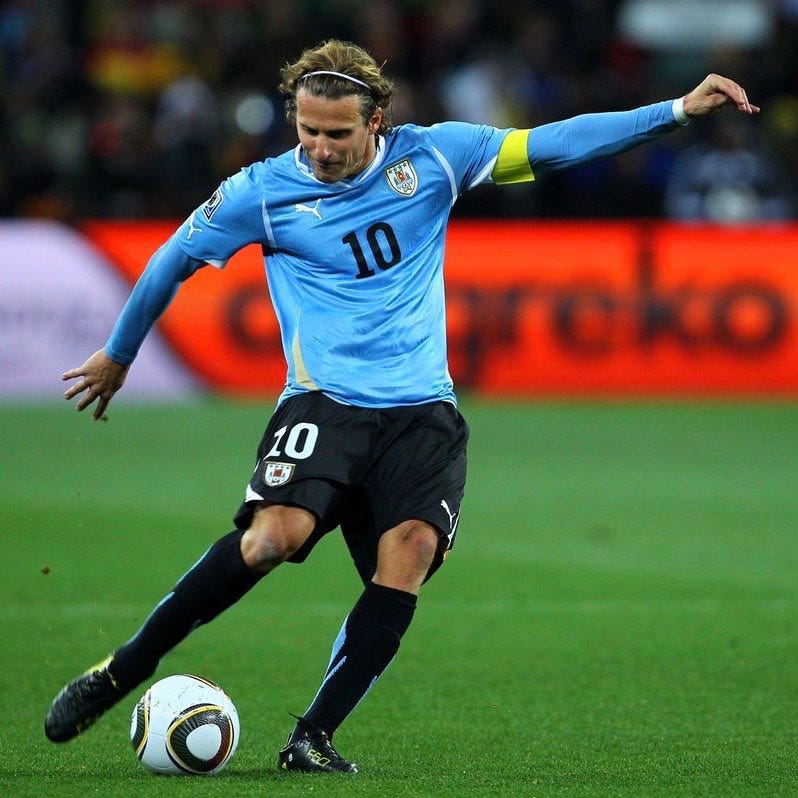
This comment highlighted the tournament's central irony: the Jabulani didn't eliminate skill from the equation—it simply redefined which skills mattered, rewarding adaptability over established technique. Players who grew up playing with lower-quality balls on uneven surfaces, including many African players, sometimes adapted more readily than Europeans accustomed to perfect conditions.
So Near Yet So Far
The Jabulani's name—"celebrate" in isiZulu—and its colorful design were meant to honor African culture. Adidas highlighted how the ball's eleven colors represented South Africa's eleven official languages and diverse communities. Yet this cultural homage was lost mainly amid technical debates about the ball's performance.
On the pitch, African teams experienced mixed fortunes. Host nation South Africa became the first host country to fail to advance from the group stage despite a memorable victory over France. Nigeria, Algeria, and Cameroon also exited early, raising questions about whether African football progressed quickly enough at the elite level.
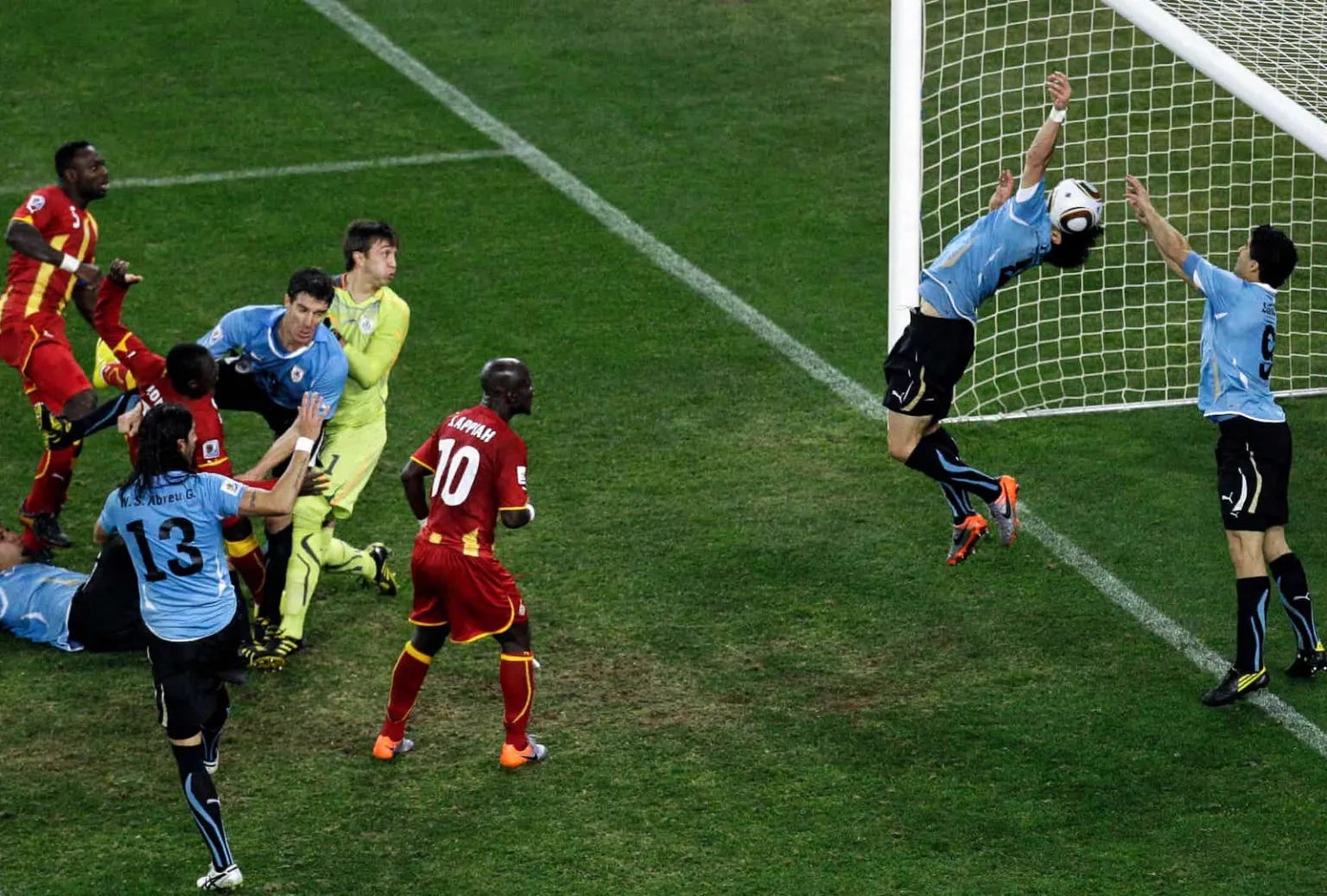
Ghana emerged as the standard-bearer, reaching the quarter-finals where they came agonizingly close to becoming the first African team to reach the semi-finals. Their dramatic exit—with Asamoah Gyan hitting the crossbar with a last-minute penalty after Luis Suárez's deliberate handball in the bout with Uruguay, which remains one of the tournament's most heartbreaking moments.
Adaptation and Excellence
Despite widespread criticism, some players excelled with the Jabulani. Understanding who adapted successfully and why offers insights into the ball's characteristics and the nature of sporting excellence.
Diego Forlán emerged as the tournament's standout performer, winning the Golden Ball award as the best player. The Uruguayan striker scored five goals, several from distance, and seemed uniquely capable of controlling the Jabulani's flight. "I practiced more than others, perhaps," he later reflected. "I saw it as a challenge rather than a problem."
Similarly, the Netherlands' Wesley Sneijder and Spain's David Villa found ways to exploit the ball's unpredictability. Sneijder noted that he adjusted his technique "to strike through the ball rather than across it," generating less spin and more predictable flight.
German players, who had months of familiarity with the Jabulani through Bundesliga use, generally performed better. This advantage raised questions about competitive fairness when equipment changes dramatically between tournaments.


Free-kick specialists like Japan's Keisuke Honda and Ghana's Asamoah Gyan developed new techniques specifically for the Jabulani, striking the ball with less spin to maintain some control over its flight path. Their success highlighted how elite athletes can adapt to changing conditions—a skill perhaps as valuable as technical perfection.
The Final Verdict
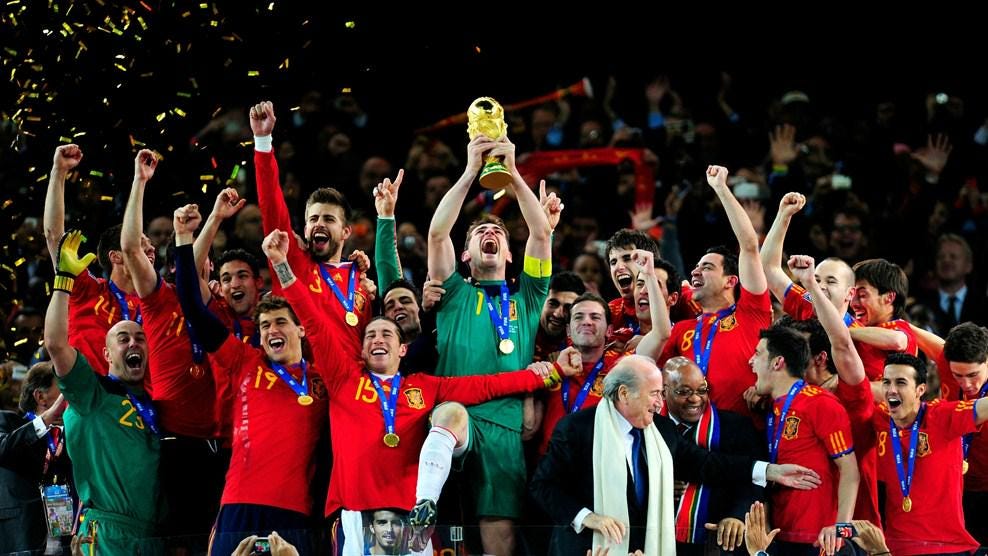
As Spain claimed their first World Cup title with a 1-0 victory over the Netherlands in the final, the ultimate winner of the Jabulani controversy remained unclear. The tournament produced memorable moments and worthy champions, yet many still regard South Africa 2010 as technically inferior due to the ball's influence.
FIFA and Adidas never officially acknowledged problems with the Jabulani, maintaining that it met all technical requirements. However, their actions spoke louder than words—the Brazuca ball developed for the 2014 World Cup in Brazil featured a completely different design with six panels and a much rougher surface texture, effectively addressing the Jabulani's most criticized characteristics.
Research conducted after the tournament validated many player complaints. A 2014 study published in the Scientific Reports journal concluded that the Jabulani was indeed more unpredictable than both previous and subsequent World Cup balls, with aerodynamic properties that created erratic flight patterns at speeds typical in professional matches.
Perhaps the most balanced assessment came from Dutch coach Bert van Marwijk, whose team reached the final: "The ball is the same for everyone. The teams and players who adapt fastest are the ones who succeed."
A Continental Achievement
While the Jabulani dominated technical discussions, South Africa 2010 achieved something more significant: it brought the World Cup to African soil for the first time in the tournament's 80-year history. This milestone represented both recognition of Africa's growing influence in world football and an opportunity to reshape perceptions of the continent.
Organizing committee CEO Danny Jordaan, who had been involved in the bid process since 1994, reflected on this journey: "When we started this bid, many people said it was impossible. Africa had never hosted before. South Africa was still emerging from a crisis. But we believed this tournament could help unite not just our nation but our continent."
The tournament's opening ceremony at Johannesburg's Soccer City stadium showcased African culture to a global audience estimated at over one billion viewers.
Ultimately, South Africa delivered what its organizing committee had promised: an African World Cup with global standards. That achievement transcends debates about ball dynamics or scoring statistics. It represents a moment when football became the world's game, no longer confined primarily to Europe and South America. Whatever one thinks of the Jabulani, that legacy deserves celebration.